
Figure 1The Mirror of Possibility
Note. Learners at work in the Swakopmund Christian Academy classroom. The school is itself the mirror this article describes: the room in which a learner meets a possible self (Markus & Nurius, 1986).
On this page· 21 sections
Excellence is not a function of size. It is a function of standards, systems and belief.
Abstract
This article argues that Swakopmund Christian Academy (SCA), a small independent school, can serve as a mirror for a nation of three million, because both must turn abundant potential into demonstrated mastery. I first review recent national data on retention, achievement and grade promotion in Namibia. I then read those data through four bodies of psychological research: mastery learning, expectation effects, self-efficacy and basic psychological needs. Against that framework, I examine SCA’s 70 percent pass mark, its merit-based promotion and its culture of knowing every learner by name. I conclude that excellence depends on standards, systems and belief rather than size, and I offer practical commitments for policymakers, families, educators and learners.
Key Points
📉Retention
Roughly one learner in every 68 left a Namibian school in 2025.
📈Mastery
The average learner taught for mastery finishes ahead of about 84 percent of a conventionally taught class.
🎯The Bar
SCA sets a 70 percent pass mark in every subject, and every learner earned promotion against it this year.
🤝What Makes It Work
High expectations work when they come with time, feedback and belonging.
Keywords: mastery learning, teacher expectations, self-efficacy, psychological needs, learner retention, Namibia
1. Introduction: The Mirror
Every school holds up a mirror to its learners. Markus and Nurius (1986) argued that people are moved by their possible selves, the futures they can picture for themselves, and that these pictures act as incentives for behaviour (p. 954). A mirror that shows children only as they are today is incomplete. A good school holds up one that also shows who they can become (see Figure 1).
Swakopmund Christian Academy is a small school, and it reflects Namibia in ways that matter. The country covers about 824,000 square kilometres of southwestern Africa. It takes its name from the Namib, widely considered the oldest desert on Earth, and it holds diamonds, uranium, copper, gold, lithium and rich fisheries (Central Intelligence Agency [CIA], 2023). Yet the most recent census counted just over three million people, only 3.7 for every square kilometre (Namibia Statistics Agency, 2024). Like SCA, Namibia is small in number and immense in possibility. Abundant space and resources are entrusted to a few, and those few must be prepared to look after them well.
The academy and the nation therefore face the same questions. How do we nurture every child? How do we turn diversity into strength? How do we make sure that an African child stands shoulder to shoulder with peers anywhere in the world? I answer through three lenses: standards, evidence and culture. My thesis is simple. Excellence is not a function of size. It is a function of standards, systems and belief.
2. Institutional Context
SCA has offered private, independent learning in Swakopmund since 1987 (Swakopmund Christian Academy, n.d.-a). The academy is non-denominational. It draws on Christian values to create a moral and supportive environment, but it does not function as a religious institution (Swakopmund Christian Academy, n.d.-b). From Pre-Kindergarten to Grade 8, learners follow an international curriculum. From Grade 9 to Grade 12, they work towards an American High School Diploma (Swakopmund Christian Academy, n.d.-a). This history matters, because it shows that the academy’s excellence was designed, not inherited.
3. The National Picture
Anyone who wants to inspire must first tell the truth, and the truth is that Namibia’s education system needs bold and thoughtful action. The retention and literacy figures below are the education ministry’s own, as reported in the national press. The examination figure is the one student organisations cited when the 2025 results were released. All were the most recent I could find at the time of writing.
Learners who left school, 2025
13,450 of 913,223 — Nangolo (2026)
Qualified for Advanced Subsidiary level, 2025
36 percent — Future Media News (2026)
Grade 3 reaching the 40 percent literacy benchmark, 2024
28 percent — The Brief (2025)
Grade 3 reaching the 75 percent literacy benchmark, 2024
3 percent — The Brief (2025)
Reaching the 75 percent numeracy benchmark
5 percent — The Brief (2025)
Note. Figures are as reported by each source. The first row equals about 1.5 percent of enrolment.
3.1 Retention
In 2025, 13,450 Namibian learners dropped out of school, out of a total enrolment of 913,223. Girls made up just over half of them (Nangolo, 2026). Large numbers can numb us, so consider the same figure at human scale. It is roughly one learner in every 68. Picture a hall of 68 desks. By the end of the year, one of them stands empty (see Figure 2). That desk belonged to a child with a name, a family and a future. When a young person leaves school early, families, communities and the national economy all lose something. Keeping learners in school is therefore an economic and social priority, not only an educational one.
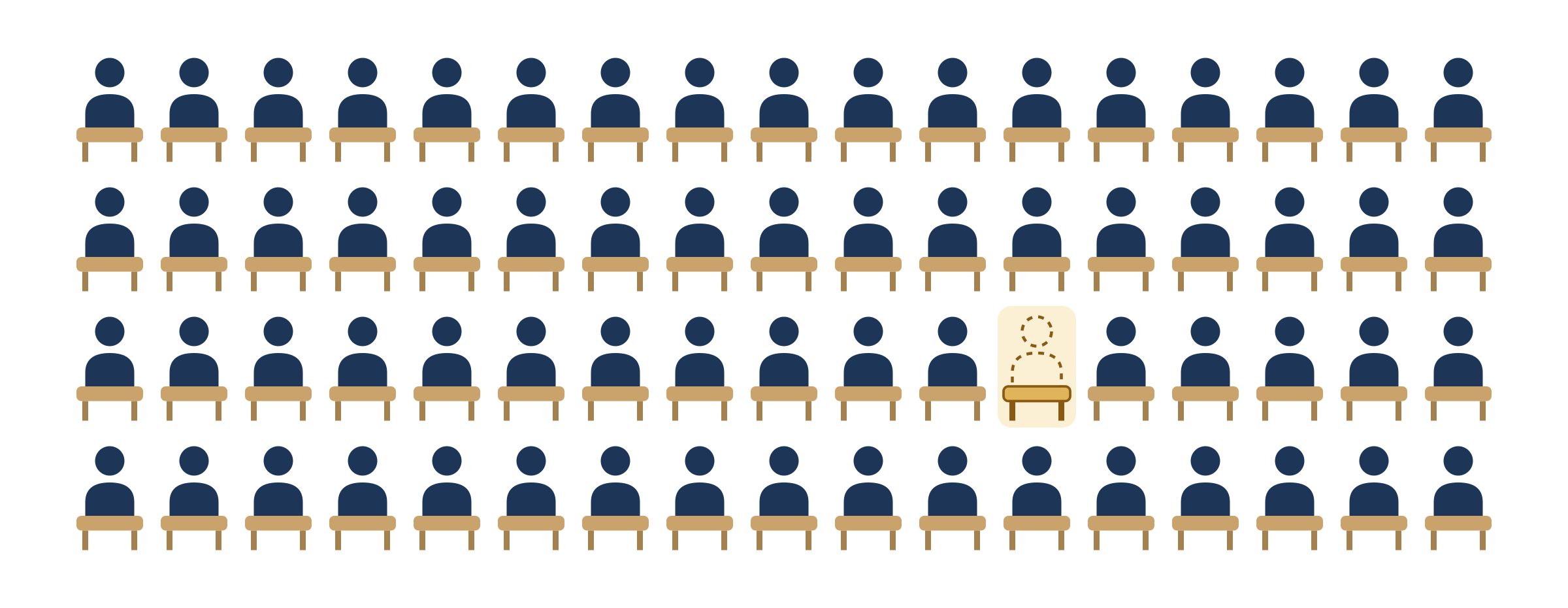
Figure 2One Desk in Sixty-Eight
Note. Each seated figure represents one enrolled learner. The empty desk represents the 13,450 learners who left school in 2025 out of 913,223 enrolled, about 1.5 percent or one in 68. Author’s calculation from figures reported by Nangolo (2026).
3.2 Achievement
The results for those who stay also demand attention. In the 2025 national examinations, only 36 percent of candidates qualified for Advanced Subsidiary level, which leaves roughly 64 percent without that pathway (Future Media News, 2026). The early grades tell a similar story. In 2024, only 28 percent of Grade 3 learners reached the 40 percent literacy benchmark. At the higher 75 percent benchmark, just 3 percent reached it in literacy and 5 percent in numeracy (The Brief, 2025).
3.3 Promotion Without Mastery
Part of the explanation lies in how learners move through the primary grades. That progression is governed by the National Promotion Policy Guide for the Junior and Senior Primary School Phase (National Institute for Educational Development [NIED], 2015), and research suggests that practice is uneven. In a qualitative study of three Erongo primary schools, Mbudhi (2022) found that only one applied the policy as required. In the Mukwe Circuit, Namene (2025) records teachers’ concerns about promoting learners who have not yet mastered foundational skills. Both are small case studies, so they cannot speak for every school. They do name the gap that the national results make hard to ignore: the gap between moving up and mastering.
These figures are not an indictment of Namibian teachers, many of whom work heroically in difficult conditions. They are a call to action, and every call to action carries an invitation to hope.
Every call to action carries an invitation to hope.
4. A Psychological Framework: Why a High Bar Helps
Why should a higher bar help learners rather than discourage them? Four bodies of research, built over more than half a century, give a consistent answer. Most of this evidence comes from classrooms outside Namibia, so I use it as a lens and not as a verdict.
4.1 Mastery Learning
Mastery learning starts from a generous premise: almost every learner can reach a high standard, given the time and help to do so. Bloom (1984) reported studies that compared three ways of teaching the same material. The average student taught for mastery finished about one standard deviation above the average of a conventionally taught class, ahead of 84 percent of that class. The average student tutored one to one finished about two standard deviations above, ahead of 98 percent (p. 4; see Figure 3). In the studies Guskey (2010) reviews, mastery is often set high, for example at 80 percent correct on a cumulative final examination. Guskey and Anderman (2013) add that the exact cutoff is a matter of professional judgement, and they recall Bloom’s conviction that up to 95 percent of students can reach a high level of mastery. What matters most is that the bar is high and that every learner gets the time and help to reach it.
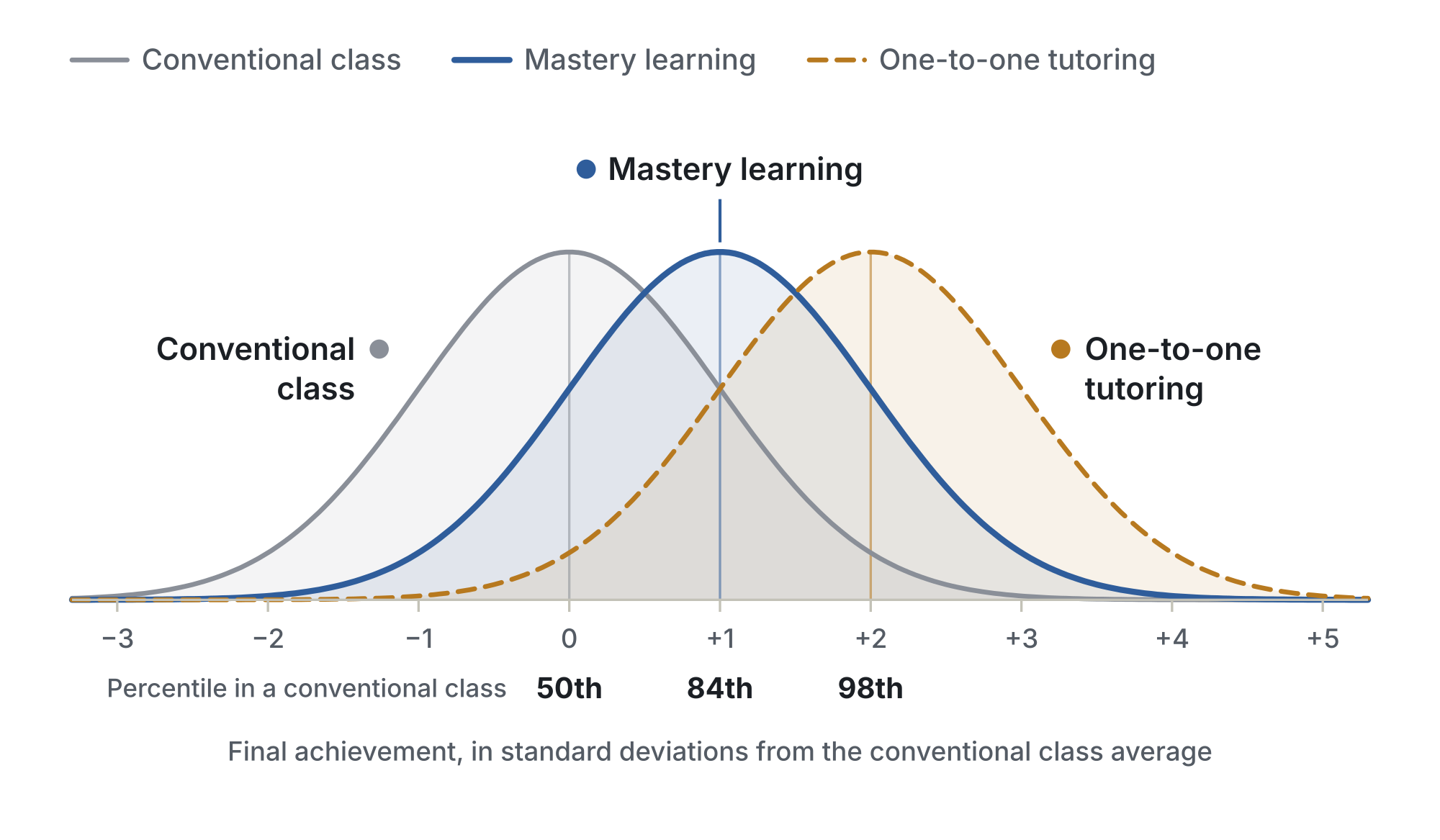
Figure 3Achievement Under Three Conditions of Instruction
Note. Schematic normal curves placed at the effect sizes Bloom reported. The average mastery learning student scored above 84 percent of a conventionally taught class, and the average tutored student above 98 percent. Adapted from Bloom (1984, p. 4).
4.2 Expectation
Standards are also a message. Rosenthal and Jacobson (1968) reported that when teachers were led to expect intellectual growth from certain pupils, those pupils, particularly the youngest, gained more on an ability test than their classmates. The finding has been debated ever since, and an honest account must say so. After reviewing 35 years of research, Jussim and Harber (2005) concluded that self-fulfilling prophecies in the classroom are real but typically small, and that powerful ones may occur selectively among learners from stigmatised groups (p. 131). The lesson is modest and still important. Belief is no substitute for teaching, but it shapes teaching. Rosenthal (1994) grouped the behaviours involved into four factors: a warmer climate, fuller feedback, more demanding material and more chances to respond. Learners notice all four.
4.3 Self-Efficacy and Mindset
Belief must be earned to last. Bandura (1997) defined self-efficacy as people’s belief that they can organise and carry out what a task demands, and he identified mastery experience as its most influential source (Chapter 3). Success that follows real effort is evidence of capability. This is why promotion earned on merit matters psychologically as well as academically: a learner who knows the pass was earned holds proof of ability that an automatic pass cannot give. A related idea is the growth mindset, the belief that ability can be developed (Dweck, 2006). In a nationally representative experiment in the United States, a short online growth mindset programme raised the grades of lower-achieving students, and its effect on grades depended on peer norms that supported the same message (Yeager et al., 2019, p. 364).
4.4 Basic Psychological Needs
Finally, motivation depends on more than marks. Ryan and Deci (2000) identify three innate psychological needs: competence, autonomy and relatedness. When these needs are satisfied, self-motivation and wellbeing grow. When they are thwarted, both diminish (p. 68). In plain terms, a learner needs to feel capable, to feel some ownership of the work, and to feel known.
💪Competence
I can do this. A 70 percent pass mark in every subject, with gaps closed before new content begins.
🧭Autonomy
This learning is mine. Learners who ask questions and accept corrections take ownership of their progress.
🏠Relatedness
I am known here. About fifteen learners to every teacher, so every child is known by name.
Note. Needs as defined by Ryan and Deci (2000, p. 68). The examples are the author’s reading of SCA’s practice.
5. The Case of SCA: Standards, Systems and Culture
5.1 Standards
At SCA, we answer the national call with standards. Our pass mark is 70 percent in every subject, and every learner this year earned promotion against it. That promotion was earned on merit, never granted automatically. In Bandura’s terms, each promotion is a mastery experience. In Bloom’s terms, it shows what learners can do when the bar is high and help is close at hand.
5.2 Systems
High standards need good systems. Each learner’s progress is monitored closely, and any gap is addressed before new content is introduced. This is the corrective loop at the heart of mastery learning, in which regular checks are followed by targeted help (Guskey, 2010). Today, our students are completing coursework for the American High School Diploma, and one student is preparing to sit the General Educational Development (GED) tests. These are not symbolic achievements. Hanushek and Woessmann (2015) show that the skills a population actually has, rather than its years of schooling alone, explain differences in long-run economic growth between nations. When an SCA learner masters algebra or scientific reasoning to an international standard, the gain belongs to that learner. It also belongs to Namibia’s economic future.
5.3 Culture
Namibia’s many cultures and languages give us a remarkable diversity. That diversity is not an obstacle to excellence. It is the raw material of excellence. SCA is committed to developing the whole child: intellectually, emotionally, socially, physically and spiritually (Swakopmund Christian Academy, n.d.-b). Its mission celebrates African heritage while embracing a global perspective (Swakopmund Christian Academy, n.d.-c). With about fifteen learners to every teacher (Swakopmund Christian Academy, n.d.-a), every child is known by name, every struggle is noticed early, and every success is celebrated. Our children are happy, and our children are safe. That is relatedness in practice, and it serves learning too. In well-run mastery learning classrooms, students reach higher levels of achievement and gain greater confidence in themselves as learners (Guskey, 2010). Wellbeing and rigour are partners, never rivals.
6. From Reflection to Action
Good intentions fade unless they are tied to a moment. Gollwitzer (1999) showed that people are more likely to act on a goal when they decide in advance what they will do in a specific situation, linking an anticipated moment to a planned response (p. 493). Such plans take a simple if-then form. I therefore close with one if-then commitment each for learners, parents, educators and policymakers, and with three questions for every reader.
🎓To our learners
Every result you earn is evidence of what you can do. Treat it as a foundation, never a ceiling. If I get an answer wrong, then I will find out why before I move on.
👪To our parents
Your sacrifice and partnership are the quiet engine behind these results. Keep believing, keep asking questions, and keep showing up. If my child brings home a result, then I will first ask what it shows they have mastered.
🍎To our educators
You have shown that high standards and deep compassion can share one classroom. Your work is a model our nation needs to see. If a learner falls short of the bar, then I will reteach before I move on.
🏛️To our policymakers
Standards and support must rise together. A higher bar without help is a barrier. A higher bar with help is a ladder. If we raise a standard, then we will fund the support that helps every learner reach it.
Pause and Reflect
🪞On belief
Whose belief in you shaped what you thought you could achieve at school?
💪On effort
When did you last earn something that was hard, and what did it teach you about yourself?
🏫On the high bar
What would change in your home, classroom or office if every child were held to a high bar and helped to reach it?
7. Conclusion
SCA is a mirror, and what it reflects is possibility. The national data show real challenges in retention, achievement and mastery. The psychological evidence explains why a high bar, honest feedback and a sense of belonging help learners rise. This academy shows what those conditions can achieve in practice. A small independent school is not the whole nation, and one case cannot prove a general law, but the principle travels. If the learners of one small school can rise to a high standard together, then three million Namibians can aspire to the same. For policymakers, the lesson is that standards and support must rise together. For families, it is that ambition is a gift. For every learner, it is that mastery is within reach.
8. A Closing Reflection
As an educator, I have learned that numbers rarely move people on their own, meaning does. I once watched a parent at a school open day frown at a report card showing 72 percent, because she had grown up believing 40 percent was a respectable result. Ten minutes later, a teacher explained that 72 percent at SCA meant her daughter had genuinely mastered the work, and that frown became pride. The number had not changed, its meaning had. That moment taught me that standards inspire only when they are explained with clarity and conviction. Let us carry that clarity into our homes and classrooms. Thank you to everyone who makes this standard possible.
References
- Bandura, A. (1997). Self-efficacy: The exercise of control. W. H. Freeman.
- Bloom, B. S. (1984). The 2 sigma problem: The search for methods of group instruction as effective as one-to-one tutoring. Educational Researcher, 13(6), 4–16.
- Central Intelligence Agency. (2023). Namibia. In The world factbook (2023 ed.).
- Dweck, C. S. (2006). Mindset: The new psychology of success. Random House.
- Future Media News. (2026, January 20). Student Union raises alarm over high Advanced Subsidiary level failure rate.
- Gollwitzer, P. M. (1999). Implementation intentions: Strong effects of simple plans. American Psychologist, 54(7), 493–503.
- Guskey, T. R. (2010). Lessons of mastery learning. Educational Leadership, 68(2), 52–57.
- Guskey, T. R., & Anderman, E. M. (2013). In search of a useful definition of mastery. Educational Leadership, 71(4), 18–23.
- Hanushek, E. A., & Woessmann, L. (2015). The knowledge capital of nations: Education and the economics of growth. MIT Press.
- Jussim, L., & Harber, K. D. (2005). Teacher expectations and self-fulfilling prophecies: Knowns and unknowns, resolved and unresolved controversies. Personality and Social Psychology Review, 9(2), 131–155.
- Markus, H., & Nurius, P. (1986). Possible selves. American Psychologist, 41(9), 954–969.
- Mbudhi, L. F. (2022). An exploration of automatic learner promotion at three schools in Namibia: Implications for quality education [Master’s thesis, Stellenbosch University]. SUNScholar.
- Namene, M. (2025). Navigating policy and practice: Teachers’ views on automatic promotion and its classroom implications in the Mukwe circuit, Namibia [Master’s dissertation, University of Zambia].
- Namibia Statistics Agency. (2024). 2023 population and housing census: Preliminary report.
- Nangolo, N. (2026, April 29). 13 450 learners drop out of school in 2025. Namibian Sun.
- National Institute for Educational Development. (2015). National promotion policy guide for junior and senior primary school phase. Ministry of Education, Arts and Culture.
- Rosenthal, R. (1994). Interpersonal expectancy effects: A 30-year perspective. Current Directions in Psychological Science, 3(6), 176–179.
- Rosenthal, R., & Jacobson, L. (1968). Pygmalion in the classroom: Teacher expectation and pupils’ intellectual development. Holt, Rinehart and Winston.
- Ryan, R. M., & Deci, E. L. (2000). Self-determination theory and the facilitation of intrinsic motivation, social development, and well-being. American Psychologist, 55(1), 68–78.
- Swakopmund Christian Academy. (n.d.-a). Swakopmund Christian Academy: Unleashing the potential of every student. Retrieved November 11, 2026.
- Swakopmund Christian Academy. (n.d.-b). Philosophy and ideology. Retrieved November 11, 2026.
- Swakopmund Christian Academy. (n.d.-c). Our vision, mission, principles and values. Retrieved November 11, 2026.
- The Brief. (2025, July 31). Steenkamp raises alarm over poor literacy and numeracy in schools.
- Yeager, D. S., Hanselman, P., Walton, G. M., Murray, J. S., Crosnoe, R., Muller, C., Tipton, E., Schneider, B., Hulleman, C. S., Hinojosa, C. P., Paunesku, D., Romero, C., Flint, K., Roberts, A., Trott, J., Iachan, R., Buontempo, J., Yang, S. M., Carvalho, C. M., . . . Dweck, C. S. (2019). A national experiment reveals where a growth mindset improves achievement. Nature, 573(7774), 364–369.